 blog
blog
Is Professional-Grade Skincare Worth It? A 2026 Guide
Table of Contents
- What Professional-Grade Skincare Actually Means
- Professional-Grade Skincare vs Drugstore: Ingredient Concentration and Formulation
- Medical-Grade Skincare vs Over-the-Counter: What the Evidence Shows
- Total Cost of a Complete Routine Over Time
- How Long Does Skincare Take to Work?
- Best Anti-Aging Serums for Your 40s: What to Look For
- Safety, Irritation, and When Professional Guidance Matters
- Conclusion: Is Professional-Grade Skincare Worth It for You?
- Frequently Asked Questions
Last Updated: October 9, 2026
What Professional-Grade Skincare Actually Means
Walk into any beauty retailer and you will see the phrase professional-grade skincare on half the bottles. The question is whether that label signals a real difference or just clever packaging. Professional-grade skincare is a category of products sold primarily through dermatologists, estheticians, and licensed skincare professionals rather than mass-market shelves.
The term itself carries no legal weight. No federal agency defines or enforces what "professional-grade" means on a label. That means any brand can print it on a jar tomorrow. What separates genuinely stronger formulas from marketing copy comes down to ingredient concentration, delivery systems, and whether a professional formulated the product for specific skin concerns.
Is the Label Regulated?
No. The FDA regulates cosmetics for safety but does not approve anti-aging claims or verify "professional-grade" language. A product marketed as professional-grade may contain the same active ingredients as a drugstore option, just at a different concentration or in a different base formula. The FDA's guidance on cosmetic labeling confirms that terms like "professional-grade" and "medical-grade" are marketing language, not regulated categories.
That does not mean the products are identical. It means you need to read the ingredient list, not the front of the bottle.
Professional-Grade Skincare vs Drugstore: Ingredient Concentration and Formulation
The real difference between professional-grade skincare and drugstore products usually comes down to two things: how much of each active ingredient is in the formula and how well the formula delivers it into your skin. A drugstore retinol might contain 0.1% retinol in a basic cream base. A professional-grade version might use 0.5% encapsulated retinol with a delivery system designed to reduce irritation while improving absorption.
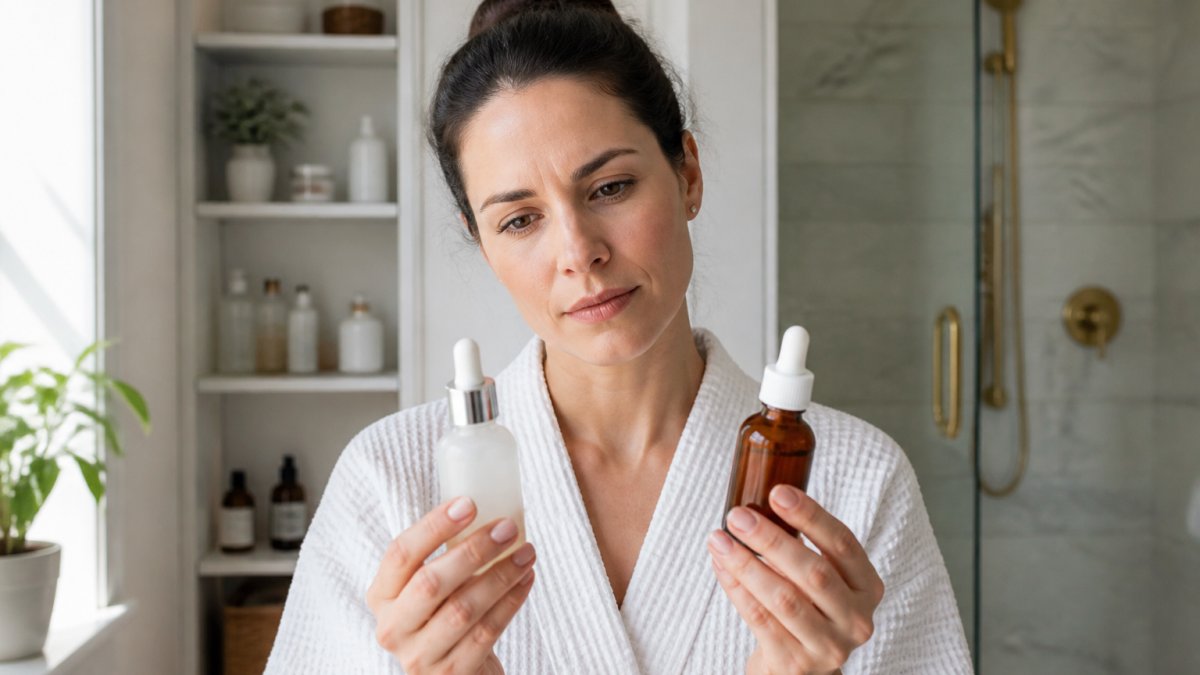
Formulation matters as much as concentration. A high percentage of vitamin C means nothing if it oxidizes before it reaches your skin. Professional formulas often use stabilized forms like tetrahexyldecyl ascorbate or include packaging that protects the ingredient from light and air.
Ingredient-by-Ingredient Comparison: Retinoids, Vitamin C, and Acids
Here is how the three most common active ingredients compare across categories:
| Ingredient | Drugstore Typical Range | Professional-Grade Typical Range | Key Difference |
|---|---|---|---|
| Retinoids | 0.01-0.1% retinol | 0.3-1% retinol or retinaldehyde | Encapsulation reduces irritation |
| Vitamin C | 5-10% L-ascorbic acid | 10-20% stabilized derivatives | Better penetration, less oxidation |
| AHA/BHA Acids | 2-5% glycolic or salicylic | 8-15% with pH optimization | Buffered formulas, professional strength |
The gap is real, but it is not automatic. Some drugstore brands now use encapsulated retinol and stabilized vitamin C at concentrations that rival professional lines. The label tells you less than the ingredient deck does.
Medical-Grade Skincare vs Over-the-Counter: What the Evidence Shows
Medical-grade skincare vs over-the-counter is not a binary choice, and the evidence does not support treating it as one. What the research actually shows is that outcomes track the active ingredient, its concentration, its delivery system, and how consistently you use it, not the channel where you bought the bottle. A retinoid purchased at a pharmacy and a retinoid purchased from a dermatologist's office both work through the same mechanism: binding retinoic acid receptors, accelerating cell turnover, and gradually remodeling the dermis over months.
Where professional-grade products can differ is the vehicle, the base formula that carries the active. A well-designed delivery system can improve bioavailability and reduce side effects like peeling and redness. That matters most for people with sensitive skin or those who have failed to tolerate standard concentrations. But a better vehicle does not create a new mechanism, and it does not rescue a product whose active is underdosed or unstable.
A Framework for Evaluating Claims and Clinical Evidence
Most brands cite "clinical studies" without linking to them. Use this checklist before you trust a percentage on a label:
- Is the study independent or brand-funded? Brand-funded studies are not automatically invalid, but independent replication carries more weight.
- How many participants, and for how long? A 12-person, two-week study cannot support claims about fine lines, which take months to change.
- Was the outcome measured objectively? Instrumented measurements of hydration, elasticity, or pigment are stronger than participant self-report alone.
- Is the full concentration disclosed? A brand that publishes its complete ingredient deck with percentages is easier to evaluate than one that hides behind a proprietary blend.
- Does the claim match the evidence type? A cosmetic product cannot legally claim to treat a disease. If a marketing page implies it cures acne or eczema, that is a signal to slow down.
FDA guidance on cosmetic versus drug claims is a useful reference for understanding where the legal line sits between cosmetic marketing and drug claims.
What Realistic Results Look Like
Expectations should be set by the ingredient, not the price. Retinoids show measurable improvement in fine lines and hyperpigmentation over roughly 12 to 24 weeks in published research. Vitamin C can improve brightness and uneven tone over 8 to 12 weeks. Acids for acne and hyperpigmentation typically need 6 to 12 weeks of consistent use. No concentration compresses that timeline, because it follows the skin's cell turnover cycle.
That framework lets you judge any product on its merits. A drugstore retinol with a disclosed concentration and a peer-reviewed backing study can be a better buy than a professional-grade serum with a proprietary blend and no published data. The label is a starting point for questions, not an answer.
Total Cost of a Complete Routine Over Time
Sticker price is the least useful number on a skincare label. What actually determines value is cost per use across a complete routine, and that math often flips the intuitive answer. A $70 professional-grade serum used twice daily for 90 days works out to roughly $0.39 per application. A $22 drugstore serum that oxidizes or loses potency after six weeks and gets replaced twice in the same window costs about $0.52 per application. The cheaper bottle is not always the cheaper routine.
To compare fairly, calculate cost per use for each step, not each product:
- Divide the price by the number of days the product realistically lasts at your usage rate.
- Add the cost of failed experiments. If you buy three $20 drugstore serums trying to find one that does not irritate your skin, that is $60 spent before you get a single usable result.
- Count the supporting products a stronger active requires. A high-percentage retinoid often needs a barrier cream and a gentle cleanser to stay tolerable, and those add to the monthly total.
A common pattern for a four-step routine (cleanser, treatment, moisturizer, sunscreen) is that a drugstore-only version runs lower per month on paper, while a mixed routine that spends more on the one or two actives doing the real work and less on cleanser and moisturizer can land in a similar range with fewer irritations. The decision is not "premium versus budget" as a category. It is which one or two steps in your routine justify a higher cost per use, and which steps are commodity products where a basic formula performs the same job.
One more variable: professional-grade products are frequently sold in airless pumps and opaque packaging that protect unstable actives, which can extend usable life and reduce how often you replace them. That is a real cost advantage, but only if the formula itself is one your skin tolerates. A product you cannot use consistently has an infinite cost per use.
How Long Does Skincare Take to Work?
Most active skincare ingredients need 8 to 12 weeks of consistent use before you see measurable change. Retinoids may show initial smoothing in 4 weeks but full results for fine lines and texture take 3 to 6 months. Vitamin C can brighten within 4 to 8 weeks. Acids for acne and hyperpigmentation typically need 6 to 12 weeks.
If a product promises overnight transformation, be skeptical. Skin cell turnover follows a predictable cycle, and no concentration changes that biology.
Best Anti-Aging Serums for Your 40s: What to Look For
In your 40s, skin loses collagen faster and barrier function weakens. The best anti-aging serums for your 40s combine a retinoid for cell turnover, a vitamin C for brightness and protection, and peptides or ceramides to support the barrier. Professional-grade formulations often package these together with concentrations that would be difficult to tolerate without professional guidance.
Look for:
- Encapsulated retinol or retinaldehyde at 0.3% or higher
- Stabilized vitamin C at 10-15%
- Peptides listed in the first five ingredients
- Fragrance-free formulas if your skin is reactive
Safety, Irritation, and When Professional Guidance Matters
Professional-grade products are not automatically safer. Higher concentrations mean higher risk of irritation, especially if you start too fast. Patch testing on your inner forearm for three nights before applying to your face is a step most people skip. If you have rosacea, eczema, or are pregnant, consult a dermatologist before starting retinoids or high-percentage acids.
Conclusion: Is Professional-Grade Skincare Worth It for You?
If you have specific concerns like photoaging, hyperpigmentation, or fine lines and you have not seen results from drugstore options, professional-grade skincare can be worth it. The concentration and formulation differences are real. But the label alone does not guarantee results, and cost per use matters more than the price on the bottle. At Radiant Essence Beauty, we offer high-quality beauty products with competitive pricing so you can build a routine that fits your skin and your budget. Shop now and find the products that match your concerns.
Frequently Asked Questions
Is professional-grade skincare worth the money?
It depends on your skin concerns and budget. Professional-grade skincare often uses higher concentrations of active ingredients like retinoids and vitamin C, which may deliver faster visible results for concerns such as hyperpigmentation, fine lines, and acne. However, drugstore options with well-formulated ingredients can also be effective. The key is matching product strength and formulation to your specific skin type and goals rather than assuming higher price always means better results.
What is the difference between professional-grade and drugstore skincare?
The main differences are ingredient concentration, delivery systems, and product access. Professional-grade skincare typically contains higher percentages of active ingredients such as retinol, glycolic acid, or vitamin C, and may use advanced delivery systems to improve absorption. Drugstore products often use lower concentrations to suit a wider range of skin types without irritation. Professional-grade products may also require a consultation with a dermatologist or esthetician before purchase, while drugstore items are available without guidance.
How long does it take to see results from professional skincare?
Timelines vary by ingredient and concern. Hydration improvements can appear within days, while retinoids typically take 8 to 12 weeks to show visible changes in fine lines and texture. Hyperpigmentation may require 12 to 16 weeks of consistent use. Sunscreen benefits are cumulative and protective rather than visible. Consistency matters more than product price. If you see no change after three to four months of regular use, the product or concentration may not be right for your skin.
Can you buy professional-grade skincare without seeing an esthetician?
Some professional-grade brands sell directly to consumers online without requiring a consultation, while others restrict access to licensed professionals. If you are purchasing without professional guidance, start with lower concentrations of active ingredients and patch test before applying to your full face. If you have sensitive skin, a history of reactions, or are treating a specific condition like cystic acne or melasma, a consultation with a dermatologist or esthetician can help you avoid irritation and choose the right products for your skin type.