 How-to
How to Find Your Skin Type: At-Home Guide
Table of Contents
- Why Knowing Your Skin Type Changes Everything
- The Bare-Face Skin Type Test: Step by Step
- How to Tell If You Have Oily or Dry Skin
- Combination Skin Signs: When Your T-Zone and Cheeks Disagree
- Dry vs. Dehydrated Skin: They Are Not the Same
- Skin Type vs. Temporary Skin Condition: How to Tell Them Apart
- Your Skin Type Can Change: When to Retest and When to See a Pro
- Frequently Asked Questions
Last Updated: October 20, 2026
Why Knowing Your Skin Type Changes Everything
Learning how to find your skin type is the first real step toward a routine that works. Your skin type shapes which cleansers, moisturizers, and treatments suit you, and which ones cause breakouts or tightness.
The reason is simple. Skincare products are built for specific skin behavior. A rich cream made for dry skin can clog oily skin. A strong gel cleanser made for oily skin can strip dry skin and leave it flaking. Get the type right, and most product decisions become easier.
Below, we walk through a repeatable at-home test you can run this week, plus how to read mixed results and spot the difference between a true skin type and a passing skin condition.
The Bare-Face Skin Type Test: Step by Step
The bare-face test is the most reliable at-home method, but a single run tells you very little. Skin behavior shifts with humidity, sleep, hormones, and what you ate the night before.

It takes about an hour per run and needs nothing but a gentle cleanser, a towel, a mirror, and something to write with.
Run it on a normal day. Skip it after a workout, a long flight, a night of heavy drinking, or a day spent in harsh sun, since those skew oil production and hydration.
Step 1: Wash With a Gentle Cleanser and Pat Dry
Wash your face with a gentle, non-foaming or low-foam cleanser and lukewarm water. Skip exfoliants, toners, clay masks, and anything with strong acids that day. Pat dry with a clean towel, then leave your skin completely bare. No moisturizer, no serum, no SPF.
Use the same cleanser for all three runs. Switching products between tests introduces a variable you cannot control, and it is the most common reason people get contradictory results.
Step 2: Leave Skin Bare and Wait 30 to 60 Minutes
Leave skin bare and wait. Thirty to sixty minutes is enough for your skin to return to its natural state. Use the time to do something else, and resist the urge to touch your face, fingers transfer oil and distort what you are trying to measure.
Keep the room at a normal temperature. A hot room, a space heater pointed at your face, or sitting directly under an air-conditioning vent will change how your skin feels within the hour and can mimic dryness or oiliness that is not really there.
Step 3: Check Forehead, Nose, Cheeks, and Chin
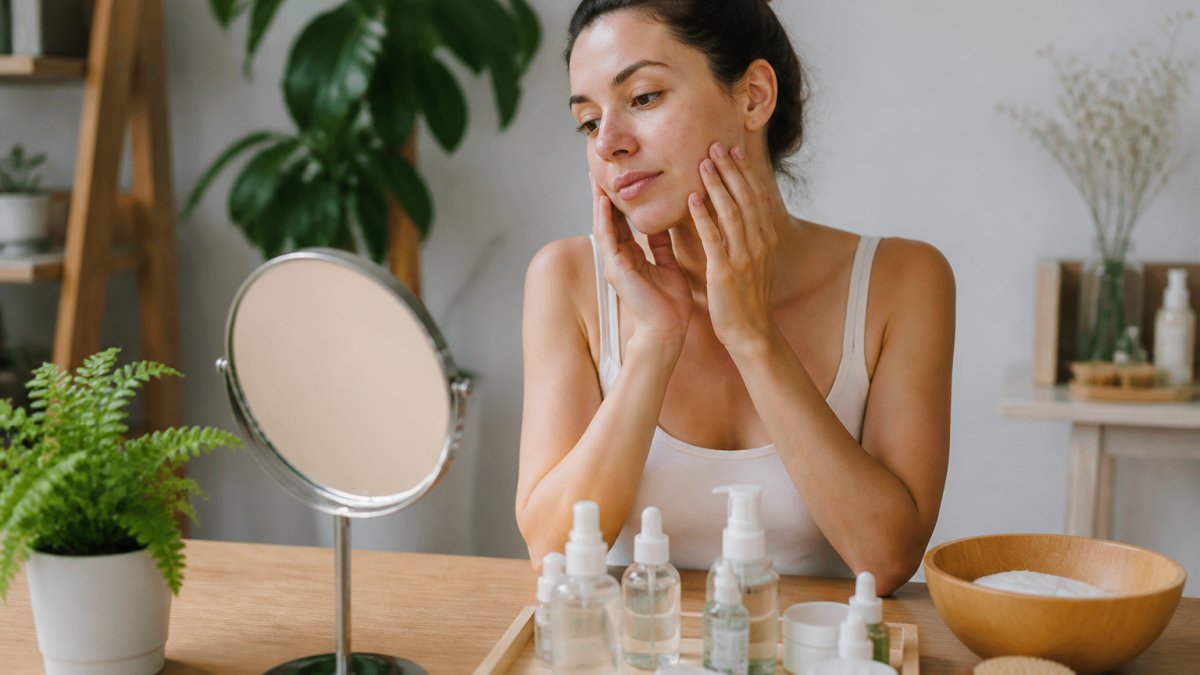
After the wait, check four facial areas in a mirror under good, indirect light: forehead, nose, cheeks, and chin. For each area, note four things:
- Shine, is there visible reflection, or does the skin look matte?
- Tightness, does it feel pulled, especially when you smile or raise your eyebrows?
- Flaking or rough texture, any visible flakes, especially around the nose, mouth, or eyebrows?
- Pore visibility, are pores obvious on the nose and inner cheeks, or barely visible?
Write it down for each area, each run. Memory is a poor record of skin behavior, and the whole point of repeating the test is to compare written notes, not recollections.
| What You Observe | Likely Skin Type |
|---|---|
| Shine on all four areas, visible pores | Oily |
| Tightness or flaking on most areas, little shine | Dry |
| Shine on forehead and nose only, cheeks normal or dry | Combination |
| Little shine, little tightness, even texture | Normal |
| Redness, stinging, or irritation after cleansing | Sensitive tendency |
Step 4: Repeat and Compare
Run the test two more times on separate days. If all three runs point the same way, you have a working answer. If they disagree, oily on Monday, tight on Wednesday, you are almost certainly looking at a temporary condition layered on top of your real type, not a type that changes daily. The next section covers how to read that situation.
How to Tell If You Have Oily or Dry Skin
The oily versus dry question usually comes down to shine and tightness, but plenty of people get both at once: skin that feels tight after washing yet looks shiny by midday. That combination is the single most common source of confusion, and it is worth working through carefully rather than picking whichever label sounds closer.
Start with the two clean signals:
- Lean oily if your forehead and nose look shiny an hour after washing, your makeup slides by midday, and your pores are visible across the center of your face.
- Lean dry if your face feels tight, looks dull, or flakes around the mouth and cheeks, and shine is rare even in the afternoon.
The Blotting-Sheet Check
A blotting sheet confirms the impression. Press a blotting paper against your forehead and nose, then against your cheek, using a fresh sheet for each area so you are not transferring oil from one zone to another.
- Visible oil on all areas points to oily skin.
- No oil and a tight feeling points to dry skin.
- Oil on the forehead and nose but not the cheeks points to combination skin.
- Oil on the sheet but skin still feels tight points to dehydration rather than true dryness, the skin is producing oil but not holding water.
If You Do Not Have Blotting Sheets
You do not need a dedicated product. A clean, plain tissue or a piece of rice paper works the same way: press, hold for a few seconds, and look for a translucent patch. Avoid tissues with lotion, aloe, or fragrance, since those leave a residue that reads as oil. Do not use a makeup-removal wipe, it will strip the area and tell you nothing.
When the Signals Conflict
If your skin feels dry but looks oily, the likeliest explanation is dehydration: the surface lacks water, so it feels tight, while the oil glands keep working normally. Treat that as a hydration problem first, a gentle cleanser, a hydrating layer such as glycerin or hyaluronic acid, and less hot water, and retest in two to three weeks.
If your results vary by area, trust the area-by-area reading over any single label. Combination skin is the most common result and the most misread, and it is covered in the next section.
If your results vary by day, go back to the repeat-and-compare protocol above. Day-to-day swings usually reflect sleep, humidity, hormones, or a new product, not a change in type.
Combination Skin Signs: When Your T-Zone and Cheeks Disagree
Combination skin is the most common result, and the most misread. The signs are simple: your T-zone (forehead, nose, chin) is oily or shiny, while your cheeks are normal or dry. You may see larger pores down the center of your face and dry patches on the outer cheeks.
Treat the two zones differently. Use a lighter gel in the T-zone and a richer moisturizer on the cheeks. One product for the whole face rarely works here, and that is not a flaw in your routine. It is just how combination skin behaves.
Dry vs. Dehydrated Skin: They Are Not the Same
Dry skin is a skin type. It produces less sebum, so it lacks oil and feels rough or tight. Dehydrated skin is a condition. It lacks water, not oil, and can happen to anyone, including oily skin.
Here is the practical difference. Dry skin needs oil-based moisturizers and gentle cleansing. Dehydrated skin responds to hydrating ingredients like hyaluronic acid and glycerin, plus more water intake and less hot water on your face. If your skin feels tight but still gets shiny by afternoon, dehydration is the likelier culprit.
Skin Type vs. Temporary Skin Condition: How to Tell Them Apart
A skin type is stable. A skin condition is a passing state caused by weather, stress, hormones, a new product, or a bad night's sleep.
Ask three questions:
- Has this lasted more than a few weeks, across different seasons?
- Did it start after a new product, a move, or a stressful stretch?
- Does it clear up when you simplify your routine?
If the answer to the first question is no, you are probably looking at a condition, not a type. Retest in a few weeks before changing your whole routine.
Skin type also changes over time. Hormones, age, climate, and stress all shift oil production and hydration. Retest once or twice a year, and again after a big move or a change in medication.
If you see persistent redness, painful breakouts, or sudden reactions that do not settle, see a dermatologist. The American Academy of Dermatology publishes guidance on when skin changes warrant a professional visit.
Your Skin Type Can Change: When to Retest and When to See a Pro
Retest every six to twelve months, and any time your skin starts behaving differently.
At Radiant Essence Beauty, we suggest keeping a short skin log: date, what you used, and how your skin felt. Patterns show up fast, and they beat guesswork when you shop for skincare products or build a routine.
When you are ready to shop, start with the basics that match your type: a gentle cleanser, one moisturizer, and a sunscreen. Add actives only after the basics feel stable.
Finding your skin type is not a one-time quiz. It is a habit: test, observe, and adjust as your skin changes.
Frequently Asked Questions
How long should I wait after washing my face to check my skin type?
Wait 30 to 60 minutes after cleansing with a gentle cleanser and patting dry. This gives your skin time to return to its natural state, so oil production and tightness show up honestly. If you assess immediately after washing, every skin type looks the same: clean and slightly tight. Set a timer, avoid touching your face or applying anything during the wait, and then examine your forehead, nose, cheeks, and chin under consistent lighting.
Can my skin type change over time?
Yes. Genetics play a role, but stress, climate, hormonal shifts, age, and your skincare routine all affect oil production and moisture levels. Skin that was oily in your teens can turn combination or dry in your 30s and 40s. That is why a skin type test is worth repeating every few months, and again whenever you move to a new climate or notice your usual products behaving differently. Retest before overhauling your routine.
What is the difference between dry and dehydrated skin?
Dry skin lacks oil and stays dry most of the time, showing flaking, rough texture, and tightness. Dehydrated skin lacks water and can happen to any skin type, including oily skin, often after too-harsh cleansing, dry indoor air, or not enough moisturizer. A simple check: if your skin feels tight but still looks shiny by midday, you may be dehydrated rather than dry. Dehydration usually improves with a hydrating routine, while dry skin needs consistent oil-based moisture.
How do I know if I have sensitive skin?
Sensitive skin reacts: redness, stinging, itching, or irritation after applying products, changing weather, or using hot water. It is often confused with a temporary reaction, so watch for patterns over a couple of weeks rather than a single bad day. Introduce one new product at a time, patch test on your jawline first, and keep a short list of what triggered a reaction. If redness or irritation persists despite gentle products, see a dermatologist for advice.