 How-to
How to Use Retinol for Beginners: A Safe Step-by-Step Routine
Quick Summary
To use retinol as a beginner, start with a low concentration of about 0.25% to 0.3% and apply a pea-sized amount at night. Use it only two nights a week at first, and increase slowly if your skin stays calm.
- Begin with a retinol concentration of roughly 0.25% to 0.3%.
- Apply a pea-sized amount to the whole face, avoiding the corners of the nose, mouth, and eyes.
- Start with two nights a week and increase only if skin feels fine.
- Wait 10 to 20 minutes after applying retinol, then add moisturizer.
- Wear broad-spectrum SPF 30 or higher every morning, since retinol increases sun sensitivity.
Table of Contents
- What Retinol Does and Why Beginners Should Start Slowly
- Choosing the Best Retinol for Beginners (Dermatologist-Recommended Options)
- How Often Should a Beginner Use Retinol? A Week-by-Week Schedule
- How to Use Retinol at Night: Step-by-Step Application
- What Cannot Mix With Retinol and Products to Avoid
- Troubleshooting Irritation, Pregnancy Precautions, and When to See a Dermatologist
- Start Your Retinol Routine With Radiant Essence Beauty
- Frequently Asked Questions
What Retinol Does and Why Beginners Should Start Slowly
Last Updated: November 19, 2026
Retinol is a form of vitamin A that helps speed up skin cell turnover, which can smooth fine lines, even out uneven skin tone, and soften the look of dark spots over time. Most people notice results slowly, often after several weeks of steady use.
Retinol is a topical skincare ingredient that belongs to the retinoid family. Once it reaches the skin, it converts into retinoic acid, the active form that works on the skin's surface and deeper layers.
Starting slowly matters for a simple reason: retinol can cause dryness, redness, stinging, and peeling, especially in the first few weeks. A slow start gives your skin barrier time to adjust.
- Begin with a low concentration, often around 0.25% to 0.3%
- Use a pea-sized amount for the whole face
- Apply a thin layer only at night
- Add moisturizer to buffer irritation
Many beginners make the mistake of applying retinol every night right away. A common mistake is expecting fast results and increasing use too soon. Your skin needs time, so patience pays off.
Choosing the Best Retinol for Beginners (Dermatologist-Recommended Options)
For most beginners, the right starting product is a low-strength, well-formulated retinol that your skin can tolerate two nights a week. The goal is not the strongest product you can find, it is the gentlest one that still delivers retinol over time.
Start with concentration, not hype
Look for a retinol concentration in the roughly 0.25% to 0.3% range for your first product. Higher percentages (0.5% and up) are not inherently better for a first-timer; they simply raise the odds of redness, peeling, and stinging before your skin has adjusted. If a label does not state a percentage, treat that as a signal to look for one that does, or choose a product explicitly marketed for sensitive or retinol-naive skin.
Match the formula to your skin type
- Dry or sensitive skin: Choose a cream or lotion formula that includes moisturizing ingredients such as glycerin, ceramides, or squalane. These buffer the retinol and support the skin barrier.
- Oily or acne-prone skin: A lightweight gel or serum is usually more comfortable and less likely to feel heavy. Look for non-comedogenic labeling.
- Combination skin: A serum layered under a moisturizer gives you flexibility, you can adjust the moisturizer by zone.
- Reactive or rosacea-prone skin: Start with the lowest strength you can find and consider the sandwich method (moisturizer, retinol, moisturizer) from night one.
Know the vitamin A family
Retinol, retinal (retinaldehyde), and retinyl esters all belong to the vitamin A family, but they differ in strength and conversion steps. Retinyl esters are the gentlest and convert to retinoic acid in multiple steps; retinol is the standard beginner starting point; retinal is one conversion step closer to the active form and is generally more potent. For a first product, plain retinol is the most predictable choice. Encapsulated retinol formulas release more slowly and are often marketed as gentler, a reasonable option for sensitive skin.
Read the label for supporting ingredients
A good beginner formula often pairs retinol with barrier-supporting ingredients. Niacinamide, ceramides, glycerin, and panthenol can help offset dryness. Conversely, a beginner product that also contains strong acids or high-dose exfoliants is a poor first choice because it stacks irritation risk.
Patch test before your first full application
Apply a small amount to your inner forearm or along the jawline for two to three nights and watch for redness, stinging, or bumps. A patch test will not catch every reaction, but it gives you an early signal before you commit your whole face.
Watch out: A "gentle" or "sensitive-skin" label is not a guarantee, some products use those terms loosely, so check the ingredient list and concentration rather than trusting the front of the package.
If you are unsure which formula suits your skin, a pharmacist or dermatologist can help you compare options. Browse our skincare selection to compare formulas.
How Often Should a Beginner Use Retinol? A Week-by-Week Schedule
Most beginners should start with retinol just two nights a week. After two to three weeks with no major irritation, you can move to every other night. Increase gradually only when your skin feels calm.
Here is a simple schedule to follow:
- Week 1: Use retinol two nights a week (for example, Monday and Thursday)
- Week 2: Keep two nights a week if your skin feels fine
- Week 3: Move to three nights a week if there is no peeling or stinging
- Week 4 and beyond: Increase to every other night if your skin stays comfortable
If your skin turns red, flaky, or burns, scale back to one or two nights a week or pause for a few days. Frequency is the easiest thing to adjust.
The schedule below sums up how to build up retinol use over the first month.
| Week | Retinol nights | Next step |
|---|---|---|
| Week 1 | Two nights a week | Keep two nights if skin feels fine |
| Week 2 | Two nights a week | Keep two nights if skin feels fine |
| Week 3 | Three nights a week | Only if no peeling or stinging |
| Week 4 and beyond | Every other night | Only if skin stays comfortable |
How to Use Retinol at Night: Step-by-Step Application
Applying retinol at night is the standard approach because sunlight can make retinol less stable and can increase sun sensitivity. Following a clear order, and knowing what a full retinol night versus a non-retinol night looks like, helps you get the most from it while keeping irritation low.
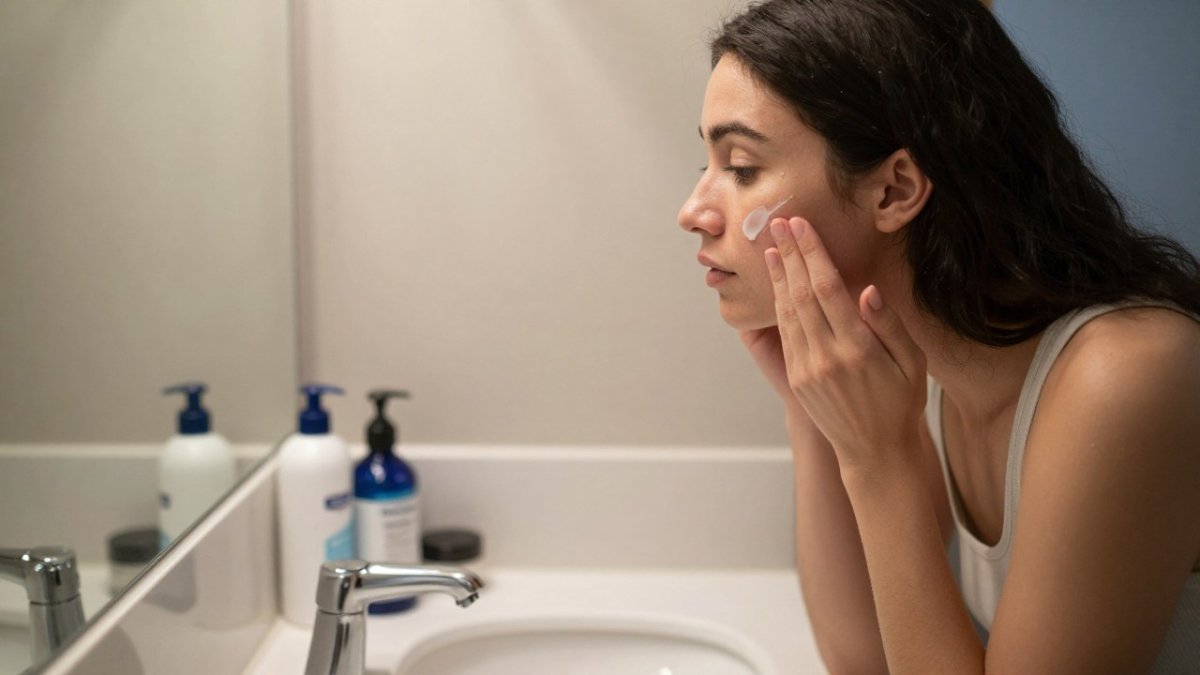
The retinol-night sequence
- Cleanse your face. Use a gentle, non-stripping cleanser and pat skin dry. Wait a few minutes so skin is not damp, since damp skin can increase penetration and stinging.
- Apply a pea-sized amount of retinol. Spread a thin layer over your whole face, avoiding the corners of the nose, the mouth, and the immediate eye area.
- Wait 10 to 20 minutes. Let the product settle before adding anything else.
- Apply moisturizer. A moisturizer helps buffer dryness and supports your skin barrier.
- Finish with your routine. If you use a night cream or facial oil, apply it last.
The sandwich method is one option for sensitive skin. Apply moisturizer first, then retinol, then moisturizer again. This lowers the strength the skin contacts and can reduce irritation.
A complete retinol night, start to finish
- Evening: gentle cleanser → optional hydrating serum → retinol (pea-sized) → wait → moisturizer → night cream or occlusive if needed.
- Morning after: gentle cleanser → hydrating serum → moisturizer → broad-spectrum SPF 30 or higher.
A complete non-retinol night
On your off nights, keep the routine simple and barrier-focused: gentle cleanser → hydrating serum → moisturizer. This is also the night to use any exfoliant or other active you are keeping in your routine, provided your skin is calm. Do not stack an exfoliant and retinol on the same night when you are starting out.
A complete morning routine
Every morning, follow your nighttime routine with a broad-spectrum SPF 30 or higher. Retinol makes skin more sensitive to the sun, so daily sunscreen is not optional. A simple morning sequence is: gentle cleanser (or water rinse) → moisturizer → sunscreen. If you use vitamin C, apply it in the morning before moisturizer and sunscreen, and keep it separate from your retinol night.
Where retinol fits in the routine order
As a general rule, apply products from thinnest to thickest. Retinol typically goes after cleansing and any watery toners or hydrating serums, and before moisturizer and heavier creams. If you use the sandwich method, the first moisturizer layer goes before the retinol.
Watch out: Applying retinol to damp skin, using too much product, or layering it with strong acids on the same night are the three most common causes of beginner irritation, keep the pea-sized amount and the wait time consistent.
What to expect during the first weeks: adjustment vs. irritation
Some dryness and mild flaking in the first few weeks is normal. This is called adjustment, and it usually settles as your skin gets used to retinol.
Irritation looks different. Watch for burning that does not fade, intense redness, swelling, or cracked skin. If these happen, stop using retinol and call a dermatologist.
- Expected adjustment: Mild dryness, light flaking, slight tingling that fades quickly
- Possible irritation: Stinging that lasts, visible redness, peeling that spreads
Results usually take several weeks to months. Keep notes on how your skin looks and feels so you can track progress.
What Cannot Mix With Retinol and Products to Avoid
Retinol works best when you keep the rest of your routine simple. Some active ingredients can make irritation more likely if you use them at the same time.
Avoid using these on the same night as retinol:
- Strong exfoliants such as glycolic or salicylic acid
- Benzoyl peroxide
- Products with high concentrations of vitamin C
- Physical scrubs or harsh cleansers
If you use these products, separate them. For example, use an exfoliant in the morning and retinol at night, or alternate nights.
Gentle, hydrating products usually pair well with retinol, especially serums and moisturizers that support the skin barrier.
Troubleshooting Irritation, Pregnancy Precautions, and When to See a Dermatologist
If irritation happens, stop retinol for a few days, then restart at a lower frequency once your skin calms. Keep using a gentle moisturizer and avoid harsh products while your skin recovers.
Retinoids are generally not recommended during pregnancy or breastfeeding. If you are pregnant, planning a pregnancy, or breastfeeding, talk to your doctor before using retinol. Also check with a doctor if you take medications that increase sun or skin sensitivity.
See a dermatologist if irritation does not improve, if you develop a rash or severe burning, or if you want help choosing a strength for your skin type.
Start Your Retinol Routine With Radiant Essence Beauty
Starting retinol works best with a simple plan: low strength, a few nights a week, and a steady moisturizer. Take it slowly, watch how your skin responds, and adjust as needed.
Shop Now to explore our selection and find a product that suits your skin.
Frequently Asked Questions
How often should a beginner use retinol?
Most beginners should start with retinol once or twice a week at night, then increase gradually to every other night as skin tolerates it. Moving to nightly use usually takes several weeks, and only if the skin stays calm with no persistent redness, stinging or peeling. Using more often than skin can handle tends to cause irritation that slows progress rather than speeding it up. Skip a night if skin feels tight or raw, and resume at a lower frequency once it has settled.
Can you use retinol every night as a beginner?
Not usually at first. A common approach is to begin two nights a week, add a third and fourth night after a few weeks of good tolerance, and reach nightly use only if skin shows no lasting irritation. Everyone's skin responds differently, so frequency should follow how your skin looks and feels rather than a fixed calendar. Pairing retinol with a fragrance-free moisturizer on the same night can make consistent use more comfortable.
What cannot mix with retinol?
Avoid layering retinol on the same night as strong exfoliants such as glycolic acid, salicylic acid scrubs, benzoyl peroxide and other retinoids, since combining them raises the odds of dryness and irritation. Vitamin C serums are often better used in the morning. Retinol can also make skin more sensitive to sunlight, so daily broad-spectrum SPF 30 or higher is essential the next day. If you use prescription acne treatments, check with your dermatologist before adding retinol.
Should you apply retinol before or after moisturizer?
For most beginners, apply a thin layer of retinol to clean, fully dry skin, then follow with a moisturizer. Moisturizer acts as a buffer that can reduce irritation while still allowing the active ingredient to work. If you have dry or sensitive skin, try the sandwich method: moisturizer, retinol, then moisturizer again. Avoid applying retinol to damp skin, which can increase penetration and the likelihood of stinging.