 How-to
How to Manage Sensitive Skin Reactions Fast
Table of Contents
- Step 1: Calm the Reaction Immediately with a 3-Day Reset
- Common Sensitive Skin Triggers and How to Identify Yours
- How to Tell Irritation, Allergic Contact Dermatitis, and Other Conditions Apart
- How to Patch Test Skincare Products Before They Touch Your Face
- Building a Sensitive Skin Care Routine That Prevents Flare-Ups
- How Long Does Skin Irritation Last? Timelines and Red Flags
- Conclusion: Your Next Steps for Calmer, More Resilient Skin
- Frequently Asked Questions
Last Updated: October 12, 2026
Step 1: Calm the Reaction Immediately with a 3-Day Reset
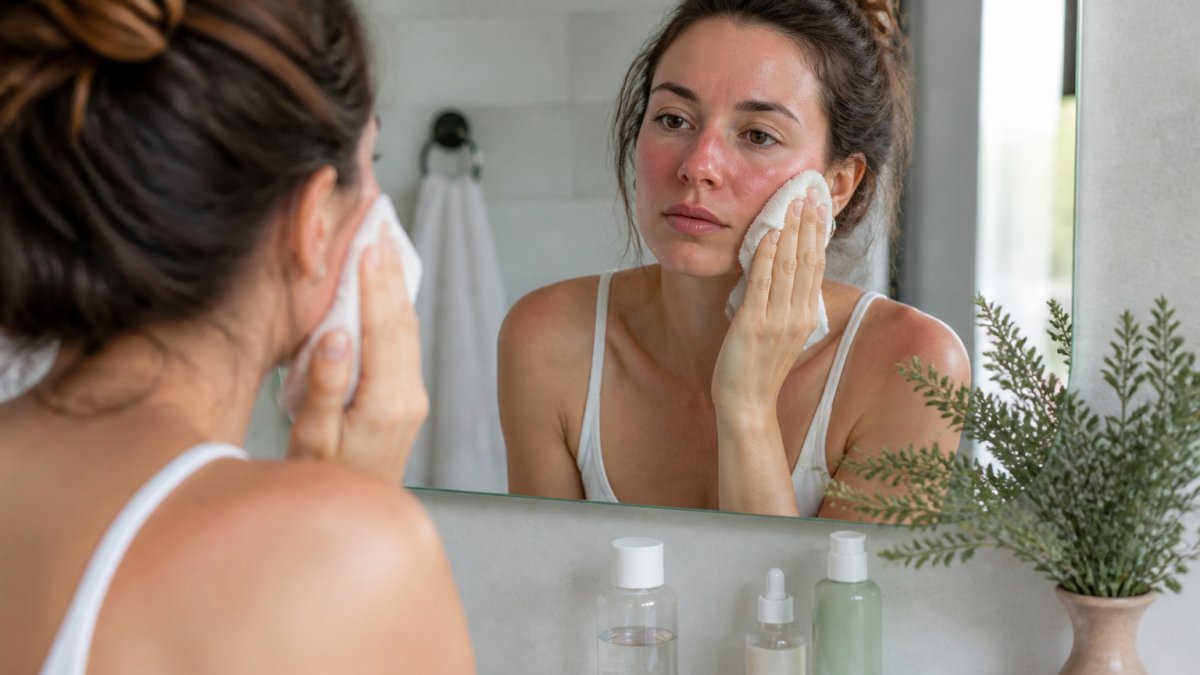
When your face is burning, stinging, or blotchy from sensitive skin reactions, the goal for the next 72 hours is not to fix your skin. It is to stop adding variables so the reaction can settle and you can see what you are actually dealing with. Most practitioners find that a stripped-back reset calms mild flares faster than any single "soothing" product, because the reaction itself is usually the skin barrier signaling that it is overwhelmed.
What to stop today
Pull these out of your routine immediately and keep them out until your skin has been calm for at least a week:
- Exfoliants and acids, glycolic, lactic, salicylic, mandelic, and any at-home peel
- Retinoids, retinol, retinal, tretinoin, adapalene
- Vitamin C in any form, including derivatives like ascorbyl glucoside
- Benzoyl peroxide, AHAs in cleansers, and physical scrubs
- Essential oils, fragrance, and "cooling" or "tingling" products, menthol, eucalyptus, and peppermint are common offenders
What to keep
You do not need to go to zero. A minimal routine of three items is enough:
- A fragrance-free, non-foaming cleanser, or plain cool water if even cleanser stings. Cream and milk cleansers are gentler than gels.
- A plain, thick moisturizer with ceramides, glycerin, or petrolatum. Apply to damp skin within a minute of rinsing to trap water.
- A mineral sunscreen with zinc oxide or titanium dioxide if you will be outside. If sunscreen stings right now, use a wide-brimmed hat and shade until the flare settles.
The 3-day reset, day by day
Day 1, Strip and soothe. Rinse with cool water only. Skip cleanser if your skin stings. Apply moisturizer while damp.
Day 2, Hold the line. Same routine. Resist the urge to add a "repair serum" or a new mask.
Day 3, Assess. Look at your skin in consistent lighting. Is the redness fading, holding steady, or spreading? Take a photo each morning so you have a real comparison instead of a memory.
How to reintroduce products safely
Once your skin has been calm for 3 to 5 days, reintroduce one product at a time, every 5 to 7 days, in this order:
- Cleanser
- Moisturizer
- Sunscreen
- One treatment active (only after the base three are stable for at least two weeks)
Patch test each item before it touches your face (see the patch testing section below). If a reaction returns after you add a specific product, you have your answer, stop that product and note it in your trigger diary.
Most mild reactions settle within a few days with this approach. If yours gets worse instead of better, spreads, blisters, or comes with swelling around the eyes, lips, or throat, stop guessing and seek care.
Common Sensitive Skin Triggers and How to Identify Yours
Sensitive skin triggers fall into two groups: things you put on your skin and things in your environment. Finding yours takes observation, not guesswork.
The usual suspects:
- Fragrance in skincare, perfume, laundry detergent, and dryer sheets
- Harsh ingredients like sulfates, alcohol, and strong acids
- Preservatives such as formaldehyde releasers
- Hot showers and hot water on the face
- Sun exposure without protection
- Weather extremes, dry indoor heat, and low humidity
How to identify yours: change one thing at a time. Keep a simple diary for two weeks. Note what you used, what you ate, the weather, and your stress level.
According to the American Academy of Dermatology's guidance on sensitive skin, fragrance is one of the most common causes of contact dermatitis, which is why fragrance-free products are the safer starting point.
How to Tell Irritation, Allergic Contact Dermatitis, and Other Conditions Apart
These problems can look nearly identical on your face, but they behave differently, respond to different steps, and carry different timelines. The single most useful clue is timing plus pattern, when symptoms started relative to exposure, and whether they stayed put or spread. This is the guide most articles skip.
The three patterns, side by side
| Feature | Irritant Contact Dermatitis | Allergic Contact Dermatitis | Eczema or Rosacea |
|---|---|---|---|
| Main feeling | Burning, stinging, tightness | Itching, sometimes intense | Itching (eczema) or flushing and heat (rosacea) |
| Speed of onset | Minutes to hours after contact | 24 to 72 hours after contact | Days to weeks, often gradual |
| Where it appears | Only where the product touched | Can spread beyond the contact area | Face, cheeks, nose, folds, hands |
| Border | Often sharp, matches the contact shape | May be blotchy and irregular | Diffuse redness or dry patches |
| Response to stopping the product | Improves within days | Improves over 1 to 3 weeks | May persist without treatment |
| First step | Stop the product, soothe the barrier | Stop the product, identify the allergen | See a provider for a diagnosis |
Why timing matters so much
Irritant contact dermatitis is direct damage. The substance, an acid, a harsh soap, a high-concentration active, breaks down the skin barrier on contact.
Allergic contact dermatitis is an immune response. Your immune system has to recognize the allergen, mount a response, and send cells to the area, which is why the reaction often appears a day or two after exposure, not immediately.
Eczema and rosacea are chronic conditions with their own triggers. Eczema tends to bring dry, scaly, intensely itchy patches, often in the same spots over time.
A simple decision path
- Did symptoms start within hours of using a product, and stay where it touched? Treat as irritant contact dermatitis. Stop the product and run the 3-day reset.
- Did symptoms appear 1 to 3 days after exposure, itch more than burn, or spread? Suspect allergic contact dermatitis. Stop the product, patch test anything new, and see a provider if it does not improve in 2 weeks.
- Have you had recurring dry, scaly, itchy patches or persistent facial flushing for weeks or months? This points toward eczema or rosacea. A dermatologist can confirm and offer targeted treatment.
- Not sure? Treat it as irritation first, it is the most common and the safest assumption, and book a dermatologist if it keeps coming back.
When to stop guessing and get help
See a healthcare provider if any of the following apply:
- The reaction is spreading after you stopped the suspected product
- You have blistering, oozing, or open sores
- Swelling affects your eyes, lips, or throat, or you have any trouble breathing, this is an emergency, call 911
- You have a fever or feel unwell
- There is no improvement after 2 weeks
- You see signs of infection: pus, increasing heat, or worsening pain
A dermatologist can run patch testing with a standard allergen panel, which identifies specific allergens rather than forcing you to avoid everything vaguely "harsh." That test is far more useful than trial and error, especially if reactions keep returning.
How to Patch Test Skincare Products Before They Touch Your Face
Patch testing is the single best way to avoid a full-face reaction. It takes a few days, and it works.
Here is how to patch test skincare products:
- Pick one product at a time. Never test two new items together.
- Apply a small amount to the inner forearm or behind the ear.
- Wait 48 hours. Do not wash the spot more than usual.
- Check for redness, itching, or bumps. Any reaction means stop.
- Repeat on your jawline for 48 more hours if the first test is clear.
- Introduce the product fully only after both tests pass.
Keep a trigger diary alongside your tests. Log the product name, the date, and any symptoms. Over a few months, you will build a personal list of safe products and known offenders. That list is worth more than any "sensitive skin" label on a bottle.
Building a Sensitive Skin Care Routine That Prevents Flare-Ups
A good sensitive skin care routine is short, boring, and consistent. That is the whole secret.
Stick to four steps:
- Gentle cleanser. Look for fragrance-free, low-foam formulas. Cream cleansers suit dry, reactive skin best.
- Moisturizer. Ceramides, glycerin, and hyaluronic acid support barrier function. Apply twice daily.
- Sunscreen. Mineral formulas with zinc oxide or titanium dioxide are less likely to sting. Wear it every day.
- One active, at most. Introduce a single treatment only after your base routine is stable for a month.
A few habits matter as much as the products. Use lukewarm water, not hot. Pat dry instead of rubbing. Avoid scrubbing tools entirely.
When you shop, look for products labeled fragrance-free and hypoallergenic, and check the full ingredient list rather than the front of the bottle.
How Long Does Skin Irritation Last? Timelines and Red Flags
Most mild skin irritation from a product clears in 1 to 3 weeks once you stop using the cause. Irritant reactions often fade in a few days.
Red flags that mean see a provider now:
- Blistering, oozing, or open sores
- Swelling around the eyes, lips, or throat
- Symptoms that keep spreading after you stop the product
- Fever or feeling unwell
- No improvement after 2 weeks
- Signs of infection, including pus, heat, or increasing pain
According to the U.S. Food and Drug Administration's guidance on cosmetic reactions, consumers should report adverse reactions to cosmetics, and a provider can help document what happened if you need to file a report.
For persistent symptoms, a dermatologist can run patch testing with a standard allergen panel. That test identifies specific allergens, which is far more useful than avoiding everything vaguely "harsh."
Conclusion: Your Next Steps for Calmer, More Resilient Skin
Sensitive skin reactions are manageable when you respond fast and stop adding variables. Calm the flare with a 3-day reset, patch test everything new, and keep your routine short enough that you can actually spot the culprit.
If you have wasted money on products that looked good but did not work for your skin, that is exactly the problem we built Radiant Essence Beauty to solve.
Shop Now at Radiant Essence Beauty and build a routine your skin can finally tolerate.
Frequently Asked Questions
What should you do first when a skincare product irritates your skin?
Stop using the product immediately and rinse your face with lukewarm water. Apply a cool compress for 5-10 minutes to reduce heat and redness. Then simplify your routine to a gentle cleanser and a plain moisturizer for at least 3 days. Avoid exfoliants, fragrances, and active ingredients like retinol or acids until your skin feels calm. If burning or swelling gets worse within 24 hours, contact a healthcare provider.
How can you identify what is triggering a sensitive skin reaction?
Keep a trigger diary for 2-4 weeks. Record everything that touches your skin: cleansers, moisturizers, makeup, sunscreen, laundry detergent, and even stress levels or weather changes. Note when redness, itching, or burning appears. Look for patterns. If a reaction happens within minutes to hours of using a new product, that product is a likely trigger. Patch testing one new product at a time also helps isolate the cause.
When should you see a dermatologist about a skin reaction?
See a dermatologist if irritation lasts more than 2 weeks, spreads beyond the original area, or comes with severe swelling, oozing, or pain. Also seek care if you have trouble breathing or swelling of the lips or throat, which can signal a serious allergic reaction. Persistent symptoms, recurring rashes, or reactions that disrupt sleep or daily life are other reasons to get professional help.
How long does skin irritation last after using a harsh product?
Most mild irritation from a harsh product improves within 3-7 days once you stop using it and switch to gentle care. Allergic contact dermatitis may take 2-4 weeks to fully clear because the immune system stays activated. If symptoms worsen after 48 hours or do not improve within a week, see a healthcare provider. Patch testing can help confirm which ingredient caused the reaction.